BioRevolution Coalition
Biology,
Engineered for growth

Backing the Bioeconomy for UK's Future Growth and Resilience

01 · PetitionParliament.uk

Add your voice.

Signing takes just thirty seconds. At 10,000 signatures the Government must respond. At 100,000 it must be considered for debate in Parliament. Every signature moves the threshold closer.

National resilience and economic growth depend on cutting the UK's reliance on imported oil, while scaling new industries that create jobs and strengthen long-term security. Bio-based Solutions use renewable bio-based resources - such as plants and agricultural wastes - to produce products more sustainably. Together, they make everyday products including packaging, clothing, cosmetics, cleaning products, fuels and medicines - a new kind of economy, the Bioeconomy. These alternatives reduce emissions and waste, while building a more self-sufficient, secure and future-ready economy.

The UK now faces a clear choice: build a world-leading bioeconomy at home, or see its science and innovation commercialised overseas. Only one path secures high-value jobs, skills and long-term economic sovereignty.

But current policy, regulatory and tax frameworks often fail to recognise the value of renewable, bio-based resources. This puts Bio-based Solutions at a disadvantage to fossil-based incumbents, locking in continued dependence on imported oil and exposing the UK to price shocks, supply chain disruption and geopolitical risk.

An urgent policy review would level the playing field, unlock investment and accelerate commercialisation. It would strengthen national security, support high-quality jobs, and position the UK as a global leader in the bioeconomy.

This is not only a climate issue - it is a modern industrial strategy and national resilience imperative. The UK has the science. Now it needs the policy to match.

You can also go further: download our template to write directly to your local MP, request a meeting, or ask them to raise a question in Parliament.

10,000
10,000 signatures needed for government response

Parliamentary Supporters

George Freeman MP
George Freeman MPMid Norfolk
Rachael Maskell MP
Rachael Maskell MPYork Central
Lord Markham
Lord Markham

Supporting Organisations

Campaign Lead
02 · What's the issue

Challenge

The problem is not the science. The technology to replace fossil oil resources with bio-based resources works, and is deployable now. The flaw is in how the system around it is governed.

Challenge 01

Innovation stalls and taxpayers' money is wasted.

The problem is not the science. The technology to replace fossil oil resources with bio-based resources, works, and is deployable now. The flaw is in how the system around it is governed.

Challenge 02

Investment is discouraged.

Higher compliance costs and policy uncertainty push investors towards fossil-based products or overseas markets.

Challenge 03

Industrial inertia continues.

Businesses remain locked into fossil resources because current policy signals favour the status quo.

Challenge 04

UK competitiveness and net zero goals are undermined.

Companies relocate abroad. Skilled jobs are lost. Over 4,000 skilled jobs and up to £500 million in annual economic value have already been foregone. Continued fossil reliance decreases our ability to reach Net Zero.

03 · Situation
The carbon question

Current situation

Carbon is a building block of modern life. Today, most of it comes from fossil resources - oil and gas.

Almost everything we use in our daily lives has carbon in it. From shampoo to clothes, mobile phones to medicines.

For more than a century we have sourced that carbon, overwhelmingly, from fossil oil and gas. It is cheap, abundant and concentrated, and our modern daily lives are built around it.

However, we now know that using fossil resources leads to climate change, and oil is becoming more expensive and less secure, both politically and environmentally.

The urgency extends beyond climate. Continued dependence on fossil carbon exposes the UK to major economic risks. A single price shock - triggered by Russia's invasion of Ukraine in 2022 - cost the UK £183 billion over four years, roughly equivalent to the entire cost of the net zero transition to 2050. Ongoing geopolitical instability continues to demonstrate how reliance on fossil resources threatens both environmental goals and economic stability.

Bio-based carbon, from bio-based resources such as plants, microbes and organic waste, offers a renewable alternative to fossil resources. This is not science fiction. Already today, we can produce bio-based alternatives to almost all oil-based ones. The UK has world-leading Bio-based Solutions research and innovation.

The science is proven. The technology works. The bottleneck is policy, not capability.

The UK does not lack innovation - it lacks joined-up rules. Companies trying to make Bio-based Solutions have to deal with different rules for where materials come from, how they are made, what the product is, and what happens to it at the end of its life. These rules often do not match up. This makes it slower, more complicated and more expensive to bring new Bio-based Solutions to market.

So while the UK does support innovation, the wider system - regulation, taxes and waste rules - does not always work together. This creates a "valley of death" where good ideas struggle to become real products people can use.

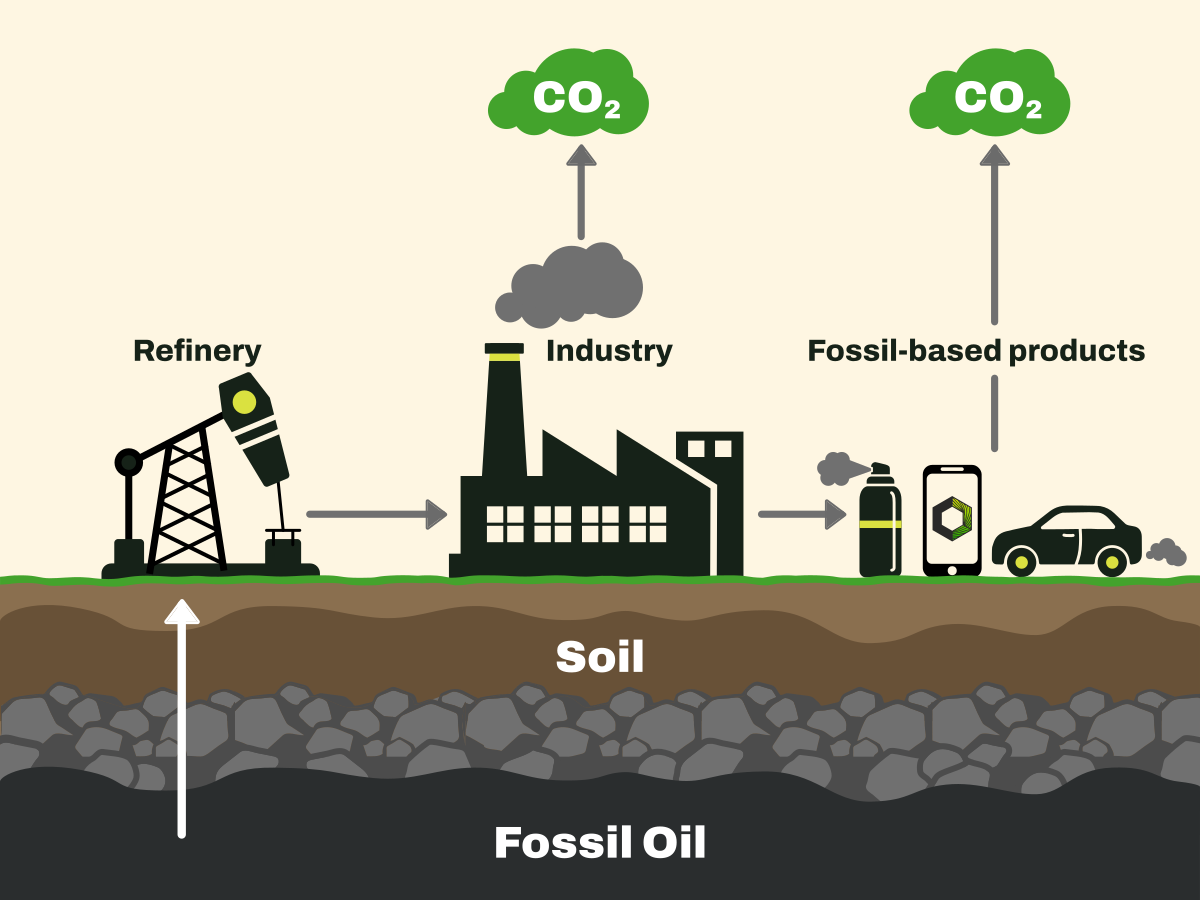
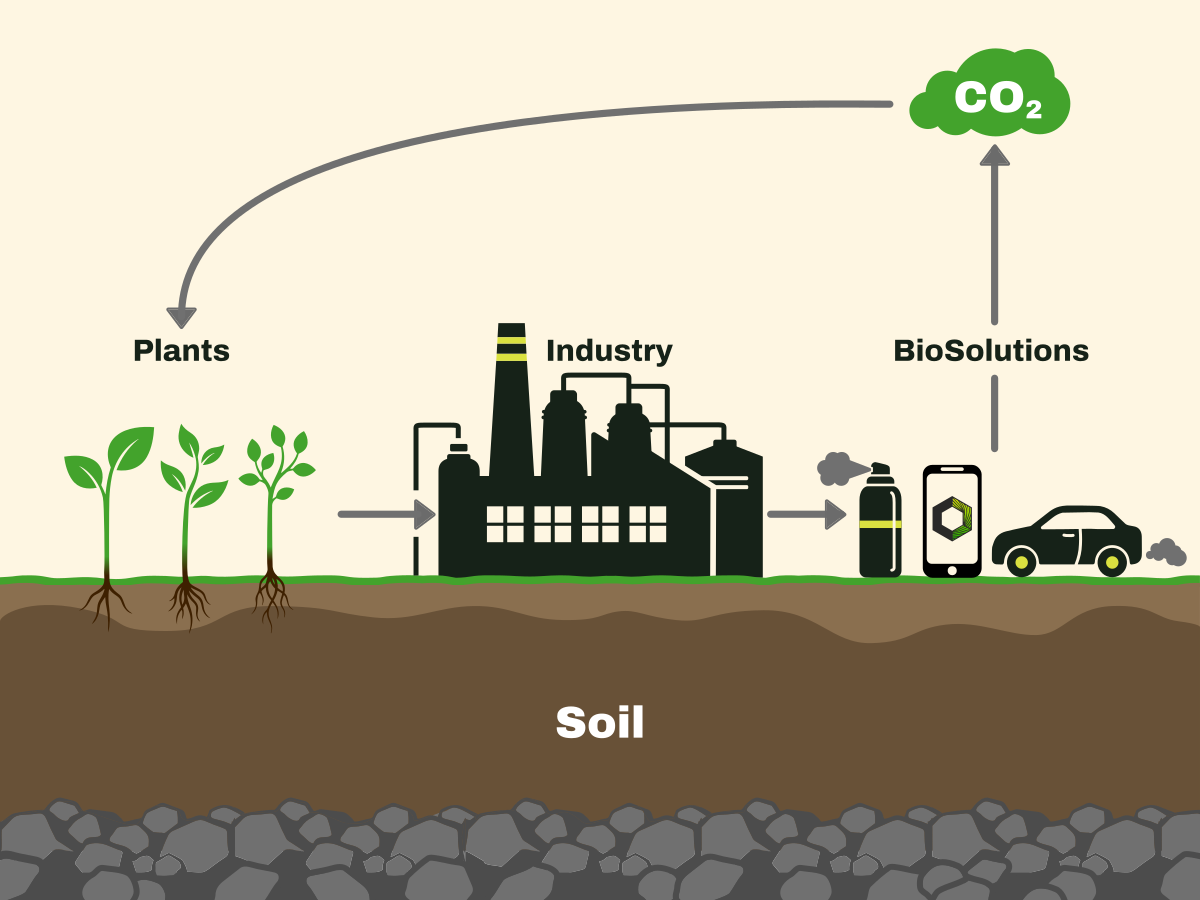
Two ways we use carbon. One adds CO2, one recycles it.
Fossil-based products
Adds new CO2 to the atmosphere

Carbon stored underground for millions of years is released, increasing CO2 in the atmosphere, leading to climate change.

Fossil-based carbon system: oil refinery extracts fossil oil, feeds an industrial factory producing fossil-based consumer products, with CO2 emitted to the atmosphere at each stage.
Bio-based Solutions
Recycles existing CO2

Plants absorb CO2 as they grow, so when it is released again, it is part of a natural cycle.

Bio-based carbon system: plants absorb CO2 as they grow, are turned into Bio-based Solutions by industry, and CO2 released returns to plants in a closed natural cycle.
04 · Bio-based SolutionsExplainer
In short

What are Bio-based Solutions?

Bio-based Solutions are everyday products made from natural, renewable bio-based resources such as plants, microbes and agricultural wastes, instead of fossil resources like oil, coal or gas. In simple terms, they use carbon from nature rather than carbon taken from underground.

How are they made?

Many Bio-based Solutions are created using engineering biology - a technology where scientists use microbes to produce useful everyday products without using fossil resources.

What are they made from?

  • Plants - crops, wood and forestry waste
  • Food and agricultural waste
  • Microorganisms - bacteria, yeast and algae
  • Seaweed and other marine materials

Common examples

You may already come across Bio-based Solutions without realising.

  • Alternative proteins made through fermentation, plant-based foods, or cultivated meat
  • Plastics made from plants like corn or sugarcane
  • Chemicals made through natural fermentation (similar to brewing beer)
  • Sustainable fabrics made from wood pulp or crop waste
  • Plant-based ingredients in cosmetics and cleaning products

Why they matter

Bio-based Solutions can help:

  • Cut carbon emissions by reducing reliance on fossil resources
  • Strengthen UK supply chain resilience
  • Create thousands of skilled jobs
  • Support rural and industrial growth
  • Help deliver Net Zero

Policy barriers

01 · Disconnected government departments
Carbon policy is currently spread across multiple government departments. On the one hand, the Department for Science, Innovation and Technology (DSIT) uses taxpayers' money to heavily fund Bio-based Solutions research and innovation. On the other, HM Treasury and the Department for Environment, Food and Rural Affairs (Defra) apply taxes and regulatory frameworks that heavily penalise Bio-based Solutions.
02 · A policy bias toward burning bio-based resources over building bio-based industry
UK biomass policy, which determines the way we use our bio-based resources, currently strongly favours their use for bioenergy - often prioritising combustion for heat and power over higher-value applications in materials, chemicals and manufacturing.
03 · No procurement signal
Government contracts - through for example the NHS - still do not routinely ask for Bio-based Solutions, even when they could. Public procurement is one of the quickest and most cost-effective ways to create early markets, but right now that opportunity is largely being missed.
04 · Regulatory hurdles mean Bio-based Solutions do not reach consumers
The Government's elongated regulatory system means it is often twice as costly, and takes significantly longer, for Bio-based Solutions to gain market approval compared to fossil-based products - discouraging innovation and economic growth.
The innovation gap
£0.5bnGVA

Lost every year, that could be in the UK's pocket.

The problem is not a lack of innovation.
It is a lack of unified policy.
05 · SolutionFive-point roadmap

A roadmap for a UK BioRevolution

The Government has already committed £2 billion over 10 years to engineering biology and the wider bioeconomy. To turn that commitment into UK industrial leadership rather than research alone, we propose the following five steps.

1

Name a government lead

One minister, one brief, one door for industry.

2

Fix the policy and taxes

Ensure policies, regulations and taxation support - rather than disadvantage - Bio-based Solutions.

3

Align carbon accounting

Align carbon accounting, lifecycle assessment and emissions reporting to reflect the benefits of Bio-based Solutions.

4

Use public procurement

Bio-based Solutions specifications in government contracts by default.

5

Back first-of-a-kind plants

Co-funded capital for the first commercial bio-refineries here.


CO2e saved annually 5m+ More than five million tonnes of CO2e could be saved annually from replacing just 12 everyday fossil-based chemicals with Bio-based Solutions. Source: BB-REG-NET 2025
Annual revenue for UK Plc £200bn Potential annual revenue by switching just 30% of UK chemicals industry feedstock to biomass. Source: BB-REG-NET 2025
New skilled jobs each year 4,500 Over 4,500 new skilled jobs created each year by reforming the UK policy environment. Source: BB-REG-NET 2025
06 · Case studies
In practice

Case studies

Three worked examples of what a coherent Bio-based Solutions policy unlocks in practice. Click to expand.

Case 01Preventing plastic pollution

How UK policy is slowing bio-based packaging.

The problem

The UK produces about 12 million tonnes of packaging waste each year, and nearly half of plastic packaging still is not recycled. Much of it is burned, releasing millions of tonnes of carbon emissions. Recycling works especially poorly for things like plastic films and small items, meaning a large share still ends up as waste. This creates a strong need for new, more sustainable packaging materials.

The opportunity

The UK Government has already recognised this. It has invested hundreds of millions of pounds into developing bio-based materials made from things like plants, seaweed and waste biomass. This sector could grow into a £4.2 billion industry, creating tens of thousands of skilled jobs while helping cut emissions.

What is going wrong

Innovation is happening - but policy is getting in the way. New bio-based packaging is more expensive to produce right now. Instead of helping it compete, current rules can actually make it even harder to adopt.

Where policy creates barriers

Bio-based materials labelled "hard to recycle"
Many bio-based options are not designed for traditional recycling. But because policy focuses heavily on recyclability, they are penalised with higher costs.
Taxes favour fossil plastics
The UK's Plastic Packaging Tax treats bio-based plastics the same as fossil-based plastics. Meanwhile, fossil plastics with recycled content can avoid the tax - making them cheaper. In reality this means that bio-based plastics are actually subsidising fossil-based ones.

Real-world impact

This misalignment is already having consequences: thousands of skilled jobs lost, hundreds of millions in economic value foregone each year, and companies relocating investment overseas.

Case 02Everyday consumer products

How outdated rules are slowing Bio-based Solutions reaching consumers.

The ambition

The UK wants to become a global leader in cutting-edge industries by 2035, including engineering biology to create Bio-based Solutions. This fast-growing sector could be worth trillions globally, and the UK has committed £2 billion in research funding to support it.

The problem

Despite this ambition, the UK's regulatory system has not kept up. Many of the rules used to approve new materials and chemicals were designed for traditional fossil-based products, not modern Bio-based Solutions. As a result, these alternatives face more complex, slower and more expensive approval processes.

What bio-based companies need

  • Clear and predictable approval processes
  • Fair, risk-based data requirements
  • Incentives that reward sustainability

Right now, they are not getting them.

Where regulation creates barriers

The difference is striking. For example, for bio-based chemicals used in cosmetics, the bio-based ingredient must go through more approval stages, takes roughly twice as long to reach market, and costs about twice as much to bring through approval compared to its fossil-based equivalent.

This means Bio-based Solutions are slower and more expensive to bring to market than traditional alternatives.

Real-world impact

These barriers are not just theoretical - they are already affecting the economy:

  • Over half a billion pounds in lost economic value each year
  • Tens of thousands of potential jobs not created
  • Smaller companies (SMEs) struggling to grow

Across the sector, the total impact could reach tens of billions of pounds annually.

Case 03Food security

How regulatory barriers are weakening UK food security.

The problem

UK food security is under growing pressure. We rely on imports for around 46% of the food we consume, including key protein sources like soy used in animal feed. This makes us vulnerable to global shocks, supply disruptions and rising prices. At the same time, livestock farming uses large amounts of land and is a major source of greenhouse gas emissions. Together, this creates a clear need for more sustainable, resilient and homegrown ways to produce protein.

The opportunity

Alternative proteins - including plant-based foods, fermentation-derived ingredients and cultivated meat - offer a way to produce protein with much lower environmental impact. They can reduce emissions, use less land and water, and strengthen UK food security. The UK already has world-class research and a growing number of innovative companies in this space. With the right support, this could become a major new industry, creating skilled jobs and driving economic growth.

What is going wrong

Innovation is happening, but companies are finding it difficult to scale and commercialise in the UK. High production costs, slow and complex approval processes, and unclear policy signals are holding the sector back. Meanwhile, other countries are moving faster to attract investment and support growth.

Where policy creates barriers

Slow and complex approvals
New alternative protein products must go through regulatory approval before they can be sold. In the UK, this process can take a long time and lacks clear timelines, delaying market entry.
Limited funding to scale
Building production facilities - especially for fermentation and cultivated proteins - requires significant investment. UK funding and incentives are currently limited compared to other countries.
Lack of market demand signals
Government buying power is not being used to support the sector. Public institutions like schools and hospitals could help create early demand but tend to favour established products.
Unclear labelling and standards
Ongoing debates about how products can be labelled create uncertainty for businesses and confusion for consumers.

Real-world impact

These barriers are already having consequences. Companies are choosing to grow and invest in other countries, funding is flowing overseas, and the UK risks missing out on a fast-growing global market. This means fewer jobs, less innovation, and a slower transition to a more sustainable and secure food system.

07 · JoinThe coalition

Are you ready to join the BioRevolution?

How you can get involved and support the transition to a bio-based future

Citizens

Sign the petition, then share it.

Thirty seconds on the Parliament site is the single most useful thing you can do today. After that, pass it to three people who might also join the BioRevolution.

Sign the petition
Industry

Bring your company on as a coalition member.

Coalition membership is free at launch. We ask for a public statement of support, a named executive sponsor and a commitment to driving change.

Parliament

Champion a change in Government policy.

We have a short brief ready for MPs, peers and councillors. It covers the five asks, local jobs impact and a suggested parliamentary question.

Request the briefing